Like residential paper and packaging recycling, Ontario’s tire recycling system operates under a producer responsibility framework, which makes obligated producers responsible for funding and managing the collection and recycling of their products at the end of their useful life. In 2019, Ontario replaced its tire recycling program, previously managed by Ontario Tire Stewardship, with a system that makes individual tire producers responsible for collecting and recycling used tires, either themselves or through Producer Responsibility Organizations (PROs).
In December 2024, the Ontario government announced changes to its tire recycling regulations, intended to give producers more flexibility in how they collect and recycle used tires and change how performance is measured. The changes, which took effect in January 2025, eliminated the collection target and changed the recycling target (known as the management target) from 85% of used tires collected to 65% of the average weight of tires supplied to Ontario in previous years.
Since then, Ontario’s tire recycling system has faced challenges, with used tires piling up across the province as operators struggled to find companies willing to pick them up, despite consumers having paid recycling fees when purchasing their tires.
According to media reports, some PROs slowed tire collection after reaching their regulatory targets, contributing to growing stockpiles of used tires.
The collection problems and regulatory changes attracted considerable media attention with headlines ranging from Hundreds of thousands of used tires piling up after Ontario cuts recycling targets (December 24, 2025) to Ontario waste depots are drowning in used tires — and experts say it is only going to get worse (July 10, 2026) to the more recent Ontario raises tire recycling target after a year of industry chaos and stockpiles across the province (September 23, 2026).
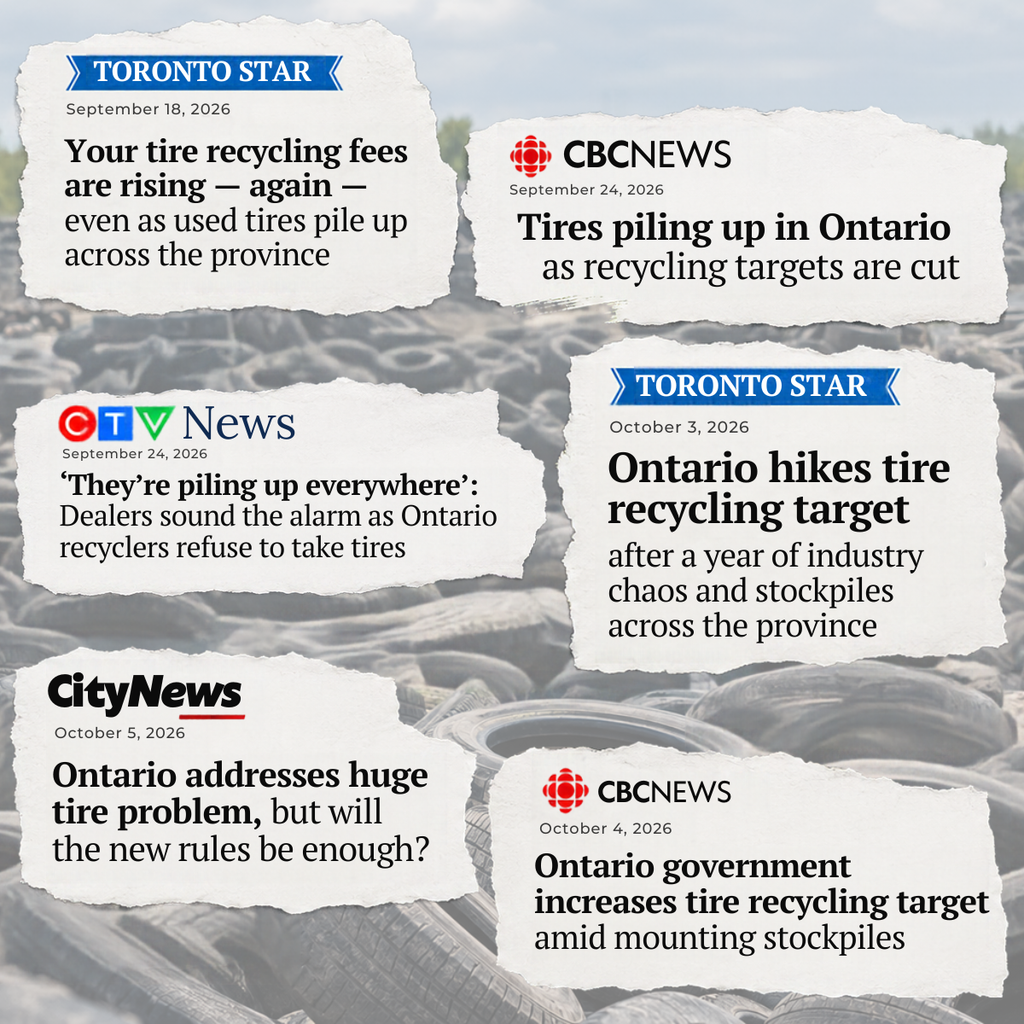
In September 2026, the Ontario government announced more changes to its tire recycling regulations, increasing the recycling target from 65% to 80% for 2026, and the number of required tire collection sites from approximately 4,300 to 6,500, starting in January 2027.
Beyond Targets
So why is the Paper and Paperboard Packaging Environmental Council (PPEC) writing about tire recycling?
PPEC recognizes it is not an expert in tire recycling, but these recent changes raise questions about how recycling policies are designed and whether meeting regulatory targets necessarily means a recycling system is working effectively.
Tires and paper packaging are different materials, with different collection systems, recycling processes, and end markets. However, both depend on a network of businesses and activities working together to make recycling possible. Governments establish the rules, producers are responsible for meeting their obligations, and PROs coordinate collection and recycling services. The system also depends on consumers, collectors, haulers, processors, recyclers, and end markets that purchase recovered materials to manufacture new products.
For PPEC, this raises a broader question: how can government recycling policy support both the collection of used materials and the businesses that turn them into new products?
For decades, Canada’s paper packaging industry has used recovered fibre to manufacture new paper packaging products, long before recycling and producer responsibility regulations were introduced. By purchasing used paper and cardboard recovered through residential and commercial recycling systems, mills provide an important end market for recycled materials, while converters turn the paper and paperboard produced by mills into new packaging.
PPEC member companies have built their businesses and operations around keeping valuable fibre in use, helping to sustain a successful, circular recycling system in Canada.
Paper Packaging in Canada: From Collection to Recycled Content
While comprehensive national data on paper and paperboard packaging recycling is limited, the available data provides some insight into the amount of paper fibre collected for recycling from residential and commercial sources.
In Ontario, the Resource Productivity and Recovery Authority (RPRA) recently reported that paper represented approximately 63% by weight of Blue Box material collected in 2025 from residential communities covered by the producer-run program.
Commercial recycling is also an important source of recovered fibre. According to the Canada Plastics Pact’s research report, Canada-wide Plastic Packaging Flows: A Progress Report, fibre accounted for an estimated 88% of packaging and paper products collected for recycling across the Industrial, Commercial and Institutional (IC&I) sector.
PPEC members often serve as end markets for these materials, with mills purchasing used cardboard and paper recovered through residential recycling programs and from commercial businesses to manufacture new paper packaging products. This is reflected in the industry’s high recycled content levels. PPEC’s Recycled Content Survey found that paper packaging produced in Canada is made primarily from recycled fibre, with an average recycled content of 86% for boxboard and 81% for containerboard shipped domestically.
These figures demonstrate the direct connection between collecting used paper and cardboard and the industry’s demand for recovered fibre to manufacture new packaging.
Recycling Policy Should Consider the Entire System
The changes to Ontario’s tire recycling requirements demonstrate how government decisions about collection requirements and targets can have implications throughout the recycling system, affecting businesses beyond those responsible for meeting the targets.
As Carol Hochu, President of the Tire and Rubber Association of Canada, recently wrote in Autosphere in the article Ontario’s Tire Collection Challenges:
Tire recycling programs depend on a complex network of collectors, haulers, processors, end markets, and regulatory oversight, and disruptions in any part of this system can create bottlenecks throughout the chain. While stakeholders continue working toward solutions, the issues have highlighted the complexity of managing one of the province’s largest circular economy systems…
The current situation serves as a reminder that recycling systems are supply chains in their own right. Collection is only the first step. Successful outcomes depend on transportation networks, processing infrastructure, end-market demand, investment, and regulatory certainty working together.
When developing or changing regulatory requirements, governments need to understand how existing recycling systems and markets for recovered materials operate, and consider how their decisions could affect the businesses and activities that keep those materials moving through the recycling system.
