
Éco Entreprises Québec (ÉEQ) recently released its 2025 Review on the Modernized Curbside Recycling System, representing the first full year operating under a full Extended Producer Responsibility (EPR) model, where producers are responsible for both funding and operating the packaging recycling system.
While Québec has had a legislated packaging EPR program in place for decades, it was under a shared responsibility model where municipalities operated recycling systems as the designated service providers, while producers – businesses that put packaging on the market in Québec – funded the costs of operating the program.
As of January 1, 2025, responsibility for Québec’s curbside recycling system shifted fully to producers, with Éco Entreprises Québec (ÉEQ) designated as the producer responsibility organization (PRO) managing the system.
British Columbia has had a full regulated EPR model for residential packaging and paper since 2014, so Québec is not the first jurisdiction in Canada to implement producer responsibility.
What makes Québec’s 2025 review important is that it provides one of the first looks at performance following a transition from a shared responsibility model to a producer responsibility model, where producers are responsible for both funding and operating the system.
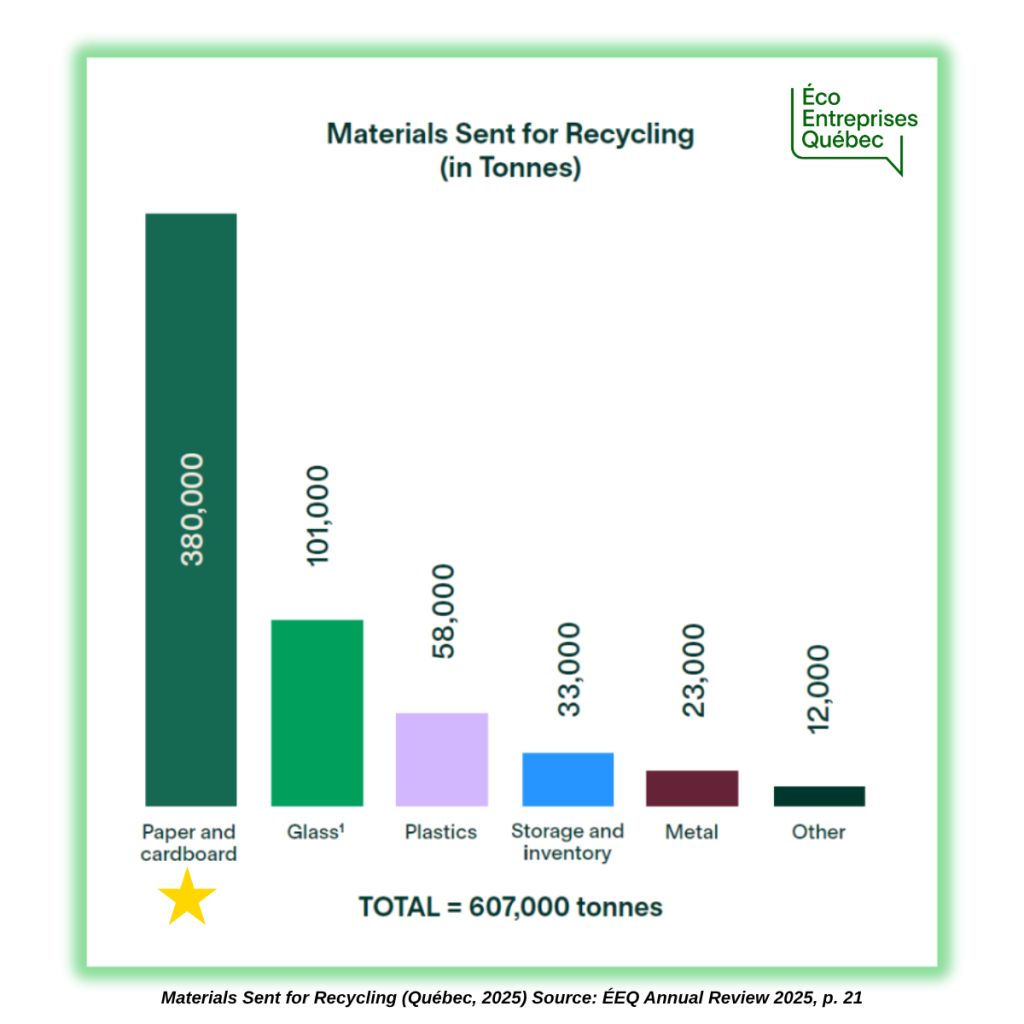
In many ways, EPR for residential paper and packaging is still in its infancy in Canada. While legislated programs have been in place for years, most provinces have operated under shared responsibility models, but many are in the process of transitioning to full producer responsibility. Against this evolving EPR landscape, Québec’s first-year results provide an opportunity to examine how a full EPR system is performing. The report shows that approximately 791,000 tonnes of material were recovered, representing an 87% residential recovery rate (materials recovered relative to those put on the market). Of that, roughly 607,000 tonnes were sent to recycling, with paper and cardboard representing more than half of collected materials and accounting for the largest share of materials sent to recycling.
Following PPEC’s LinkedIn post on the report, we received a few comments that highlighted different ways of interpreting the data, which prompted us to take a closer look at how recycling performance is measured and understood.
One comment translated the results into a per-household recycling figure, suggesting that the amount recycled per household appeared low.
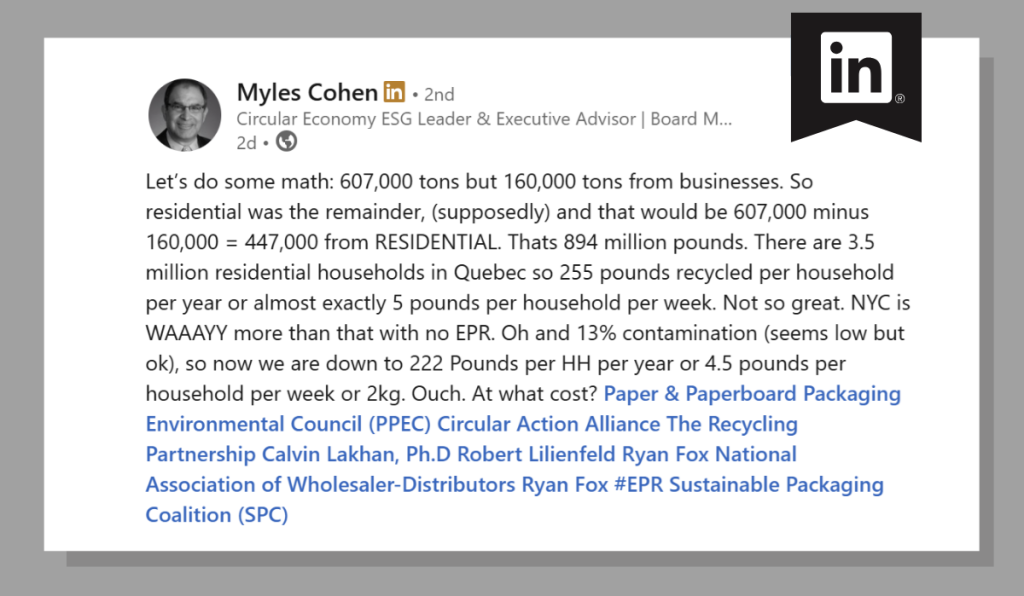
Converting EPR system data into per-household figures can make the numbers feel more tangible, but it also introduces challenges. These types of calculations rely on assumptions that all households participate in recycling and that all material placed in the system is successfully recycled. In practice, participation varies, and not all materials are actually recycled.
However, the underlying concern from the commenter of whether residents are actually recycling is valid. A recent study by RECYC-QUÉBEC, the province’s recycling and waste management agency, found that a significant share of litter could have been recycled. Recyclables made up over 70% of the weight of highway litter and approximately 40% of shoreline waste, according to the 2023 Waste Characterization Study.
These findings reinforce that even where EPR recycling programs are performing well, not all materials are recycled. Some materials never enter the system in the first place, while others are lost due to consumer behaviour, contamination, product design, or challenges in sorting and processing.
This points to a broader reality: EPR is not a catch-all solution for every packaging and waste management challenge. Another comment on our post highlighted that recovery rates vary across materials, with stronger performance from fibre.
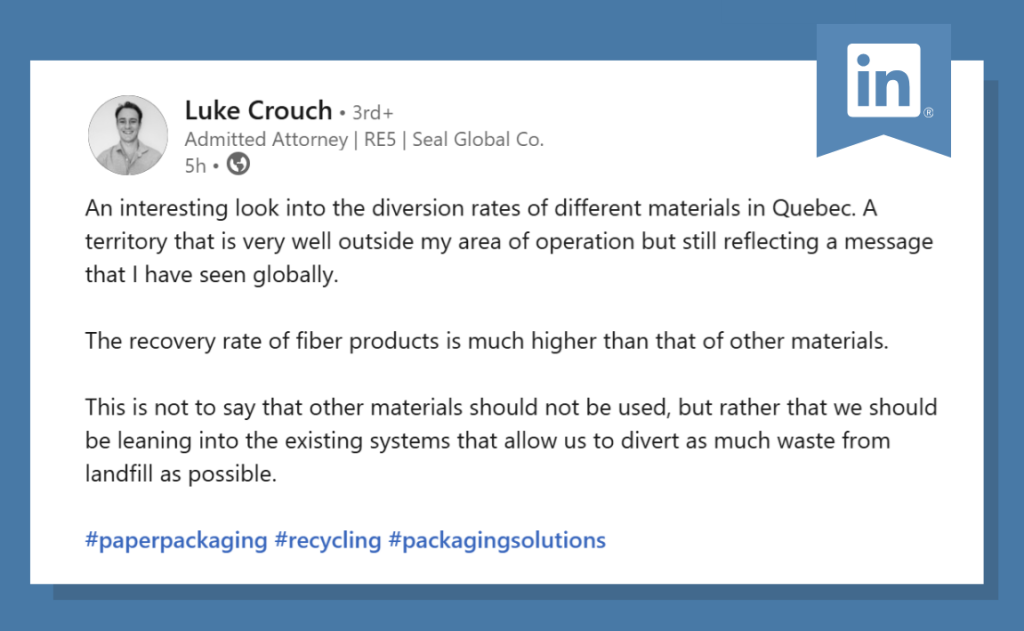
In Québec, paper and cardboard account for the largest share of materials collected and sent to recycling. This reflects the fact that fibre is widely accepted in recycling programs and supported by well-established end markets. Recovered paper is a primary feedstock for new paper packaging, creating a circular system where materials are not only collected and sorted, but also consistently purchased and reused. This is not incidental. Paper and cardboard are the backbone of recycling systems, reflecting decades of investment by the paper packaging industry in building end markets and using recovered fibre in their operations.
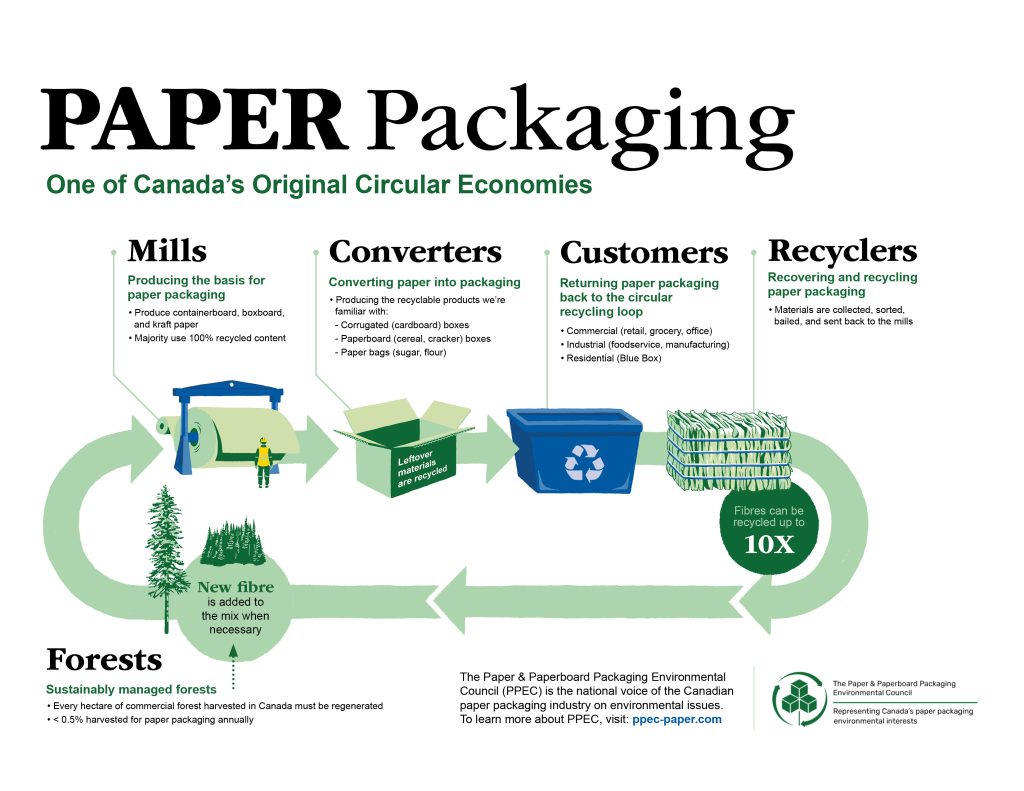
Collection is only one part of the system. Materials must also be sorted, processed, and ultimately purchased and reused for recycling to occur in practice.
As EPR expands, systems are being asked to manage a broader and more complex mix of materials, under varying provincial approaches and evolving consumer behaviours, including increased reliance on convenience, delivery, and takeout packaging.
These are not simple systems to design or operate, which is why data matters.
Data helps distinguish between what is collected – what is placed in the recycling bin – and what is actually recycled. In Canada, this is further complicated by the fact that recycling data is reported provincially, with differences in methodology, scope, and measurement approaches across jurisdictions. Not everything that is collected is ultimately recycled.
Where data is clear and consistent, it can support better policy and business decisions. Where gaps or inconsistencies exist, it can lead to confusion and differing interpretations of what success looks like.
As EPR continues to evolve across Canada, the focus should not only be on shifting responsibility, but also on ensuring that all parts of the system – from how materials are designed and used, to how they are collected, sorted, and ultimately recycled – are working together. How recycling data is interpreted matters, because it shapes how we understand system performance, and how we design, evaluate, and improve recycling systems going forward.
